


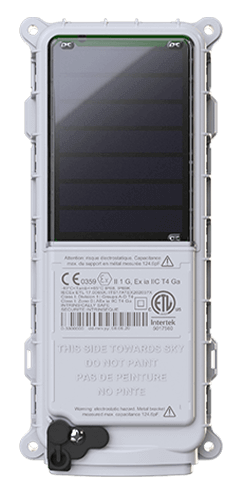
 SmartOne Solar
 SmartOne C
 STX3
STX3
 SPOT X
 SPOT Gen4
 SPOT Trace
Keeping Rail Operations Connected Beyond the Network Edge
Rail networks are among the most complex transportation systems in operation today.
Compared to other transportation sectors, rail has historically relied on a patchwork of legacy approaches to visibility, from trackside RFID to manual reporting, with limited adoption of continuous telematics. As a result, many rail operations still lack real-time insight into asset location and conditions in the transportation sectors. Rail has historically relied on a patchwork of legacy approaches to visibility beyond fixed infrastructure. This creates a significant opportunity to modernize rail connectivity and leapfrog directly to more resilient, always-on monitoring models.Trains move continuously across national borders, rural corridors, tunnels, yards, ports, and industrial zones. Assets span thousands of miles of track, much of it far from population centers. Yet despite the scale and importance of rail infrastructure, connectivity remains uneven across large portions of the network.
As rail operators pursue digital transformation initiatives — from asset monitoring and condition-based maintenance to safety systems and operational analytics — connectivity gaps have become a limiting factor. Without consistent communications, even the most advanced systems struggle to deliver their intended value.
Why Connectivity Is Foundational to Modern Rail Operations
Rail operations increasingly depend on data to maintain safety, efficiency, and reliability. Location tracking, telemetry, status reporting, and alerts support everything from rolling stock management to infrastructure maintenance and regulatory compliance.
These systems assume reliable connectivity. When communications drop, visibility is lost. Railcars may go untracked. Condition alerts may be delayed. Operational teams are forced to rely on manual processes or incomplete data, increasing risk and inefficiency.
For rail, where safety margins are narrow and downtime is costly, connectivity is no longer a supporting function. It is part of the operational backbone.
The Reality of Rail Coverage Gaps
Rail lines often run through precisely the areas where terrestrial networks are weakest.
Remote stretches of track, mountainous terrain, coastal corridors, tunnels, and industrial zones all pose challenges for cellular coverage. Even in regions with otherwise strong networks, coverage can fluctuate dramatically along a route. By design, rail infrastructure is often routed through sparsely populated or industrial areas, shaped by land use constraints, zoning policies, and considerations for communities. Even high-trafficked rail corridors frequently pass through regions with limited or no terrestrial network investment.
This inconsistency creates blind spots that undermine monitoring strategies. A railcar may report reliably in one region, then disappear for hundreds of miles before reconnecting. For operators managing large fleets, these gaps complicate planning, disrupt workflows, and increase the cost of oversight.
Maintaining Visibility Beyond Fixed Infrastructure
Satellite connectivity addresses these challenges by operating independently of ground-based networks. Instead of relying on proximity to towers, satellite-connected devices maintain communication wherever they have a clear view of the sky.
For rail operators, this means consistent asset visibility across the entire route — not just near cities or terminals. Railcars, locomotives, and infrastructure sensors can continue reporting location, status, and alerts even when operating far beyond cellular coverage.
Visibility requirements in rail are also expanding beyond basic location awareness. Customers increasingly expect insight into how goods are handled while in transit, not just where they are. This includes monitoring conditions such as temperature, shock, dwell time, and other environmental factors that impact cargo integrity.
This persistent visibility supports more accurate tracking, better utilization, and faster response to incidents, regardless of geography.
Supporting Safety and Compliance Across the Network
Rail is a heavily regulated industry with strict safety and reporting requirements. Monitoring hazardous materials, tracking asset movements, and maintaining audit trails are critical responsibilities. Connectivity gaps introduce risk by creating uncertainty around asset status and location.
Safety and compliance in rail operations depend heavily on timely system visibility, particularly when incidents occur. brakes status is often the first and most critical question during service disruptions or emergency scenarios. The ability to remotely monitor the system health in real time provides operators with faster situational awareness, enabling quicker decision-making, improved incident response, and more effective coordination with maintenance and safety teams across the network.
Satellite-enabled monitoring helps close these gaps by ensuring critical data continues to flow even when terrestrial networks are unavailable. This supports compliance efforts while also improving situational awareness for operational and safety teams.
In the event of an incident, consistent connectivity can make the difference between delayed response and timely intervention.
Enabling Scalable, Low-Maintenance Deployments
Rail assets are often deployed for years and operate across vast distances. Monitoring solutions must be durable, power-efficient, and capable of functioning with minimal maintenance. Battery-optimized satellite IoT devices are well-suited to these environments, supporting long-term deployments without frequent servicing.
Rail cars operate much like transport trailers. There are significantly more rail cars than locomotives, and most lack a dedicated power source. Yet these unpowered assets represent a major opportunity for improved utilization and revenue optimization. Scalable, low-maintenance monitoring enables operators to capture location and usage data across large fleets of rail cars, helping identify idle assets, improve turnaround times, and maximize revenue per car without adding operational complexity.
This allows rail operators to scale monitoring initiatives across fleets and infrastructure without proportionally increasing maintenance costs or operational complexity.
Building a More Resilient Rail Network
As rail networks modernize, resilience has become a strategic priority. Weather events, network outages, and infrastructure disruptions all test the limits of traditional communications. Satellite connectivity adds an additional layer of resilience by reducing dependence on any single network type.
By extending connectivity across the full rail footprint, operators gain a more complete operational picture and a stronger foundation for digital transformation.
For rail, closing the connectivity gap is not about replacing existing systems. It is about ensuring that critical data remains available wherever trains travel, enabling safer, more efficient, and more reliable operations across the entire network.
Reach out to our team of experts to learn more.

