


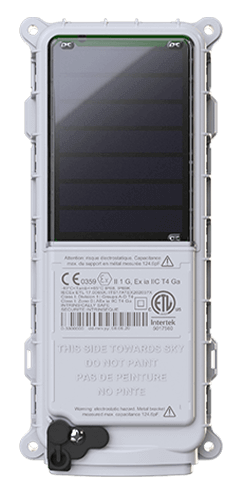
 SmartOne Solar
 SmartOne C
 STX3
STX3
 SPOT X
 SPOT Gen4
 SPOT Trace
How Solar Power Enables Remote IoT Deployments
As IoT deployments continue to expand beyond cities, warehouses, and highways, one challenge consistently comes into focus: power. Many remote and mobile assets operate far from fixed electrical infrastructure, requiring solutions that can function reliably and efficiently over long periods of time.
In response, IoT power strategies have evolved. Battery-powered devices continue to play an essential role across many use cases, offering simplicity, compact form factors, lower upfront cost, and flexibility for covert or line-powered installations. At the same time, solar-powered IoT devices are emerging as a powerful complement, enabling new levels of data availability and operational efficiency in the right environments.
Rather than replacing battery-based designs, solar expands what’s possible when deployments demand greater autonomy, richer data, and reduced hands-on maintenance.
The Power Challenge in Remote IoT
Many IoT applications exist precisely where infrastructure does not. Assets travel across rural transportation corridors. Equipment is deployed in isolated fields, forests, and industrial sites. Monitoring points are installed in locations that are difficult or costly to access.
In these environments, power planning becomes a critical design consideration. Battery-powered devices are often optimized for predictable, low-frequency reporting such as periodic heartbeats, basic location updates, or simple status alerts. For these scenarios, batteries remain an effective and efficient choice.
As deployments scale or reporting requirements become more dynamic, however, power strategy must account for variability. Assets may alternate between stationary and in-motion states. Sensors may be added over time. Data requirements may evolve. Designing around a fixed power budget becomes more complex as use cases mature.
This is where solar power can add meaningful flexibility.
Solar Power Unlocks Data Flexibility
The most immediate advantage of solar-powered IoT devices is freedom in data reporting.
Battery-powered designs encourage careful selection of what data is sent and how often. That discipline is valuable, but it can also limit granularity when asset behavior becomes less predictable. Solar-powered devices, by continuously replenishing energy from ambient light, allow for more adaptable reporting models.
This enables:
- Higher message frequency when conditions demand it
- Variable reporting based on asset movement or status
- Support for BLE-connected sensors that require intermittent bursts of power
- Greater visibility when assets shift between idle and active states
Instead of designing for the lowest common denominator, solar allows IoT systems to respond dynamically to real-world conditions, delivering more insight without constant trade-offs.
Solar and Satellite: Designed for Independence
When paired with satellite connectivity, solar power fundamentally changes what’s possible for remote IoT.
Both technologies are built for environments where terrestrial infrastructure is unavailable, unreliable, or impractical. Satellite IoT communication relies on efficient, narrowband data transmission: small packets carrying location updates, sensor readings, and status messages rather than continuous high-bandwidth streams.
This model aligns naturally with solar energy harvesting. Devices can maintain consistent reporting schedules, adapt message frequency as needed, and operate independently of cellular coverage or grid power.
The result is resilient, always-on monitoring that functions across geographies, terrains, and operational conditions.
Supporting Stationary and Mobile Assets
Solar-powered satellite IoT devices are well suited to both long-term stationary deployments and highly mobile assets.
For stationary assets such as containers, trailers, or remote equipment, solar power enables continuous monitoring over extended periods without reliance on fixed power sources. Devices can support richer data collection with minimal intervention.
For mobile assets, solar charging helps balance fluctuating usage patterns. Devices recover power during daylight, idle time, or transit, maintaining readiness even when movement patterns are irregular or difficult to predict.
This flexibility supports applications ranging from asset tracking and environmental monitoring to compliance reporting and safety oversight.
Power Resilience Is Operational Resilience
Reliability is not just a function of network coverage. A connected device that runs out of power is effectively offline, regardless of how robust the network may be.
Solar power adds an additional layer of resilience by reducing dependence on finite energy sources. In environments where maintenance access may be delayed by weather, logistics, or operational constraints, self-sustaining devices help ensure continuity.
Equally important, solar enables greater data availability when it matters most. Instead of rationing messages, organizations can prioritize visibility and responsiveness especially in scenarios where asset behavior changes unexpectedly.
Enabling Sustainable IoT at Scale
Beyond operational benefits, solar-powered IoT aligns with broader sustainability goals. Fewer battery replacements reduce material waste. Fewer maintenance visits lower fuel consumption and emissions.
As organizations increasingly evaluate IoT investments through both financial and environmental lenses, solar offers a way to scale data-driven operations without proportionally increasing resource consumption.
Choosing the Right Power Strategy
As IoT deployments become more distributed, autonomous, and long-lived, power strategy becomes a foundational design decision. Battery-powered and solar-powered devices each serve distinct purposes, and the most effective deployments often use both.
Solar-powered satellite IoT devices provide a path to greater data flexibility, reduced maintenance, and long-term resilience, particularly in environments where visibility requirements evolve over time.
By removing power as a limiting factor, organizations can focus on what IoT is ultimately meant to deliver: insight, responsiveness, and control wherever operations take place.
Learn more at globalstar.com

